



Inpatient Acute Rehabilitation Facility (IRF)
Our IRFs give hope to individuals who need intensive acute rehabilitation.
Our experienced team utilizes an interdisciplinary, coordinated approach with the goal of maximizing each patient’s functional independence and facilitating a safe discharge back home.
Inpatient Acute Rehabilitation Facility (IRF)
Our IRFs give hope to individuals who need intensive acute rehabilitation.
Our experienced team utilizes an interdisciplinary, coordinated approach with the goal of maximizing each patient’s functional independence and facilitating a safe discharge back home.
Inpatient Rehabilitation at a Glance

Physiatry-led rehabilitation care

24-hour nursing and medical supervision

15 hours of therapy per week

Coordinated discharge planning focused on returning home
Inpatient Rehabilitation at a Glance
24-hour nursing and medical supervision
Physiatry-led rehabilitation care
15 hours of therapy per week
Coordinated discharge planning focused on returning home
From Medical Recovery to Functional Rehabilitation
After a hospital stay, many patients need intensive therapy and medical oversight before safely returning home. Inpatient rehabilitation provides the next stage of recovery, helping patients rebuild strength, mobility, and independence.
Typical Care Progression
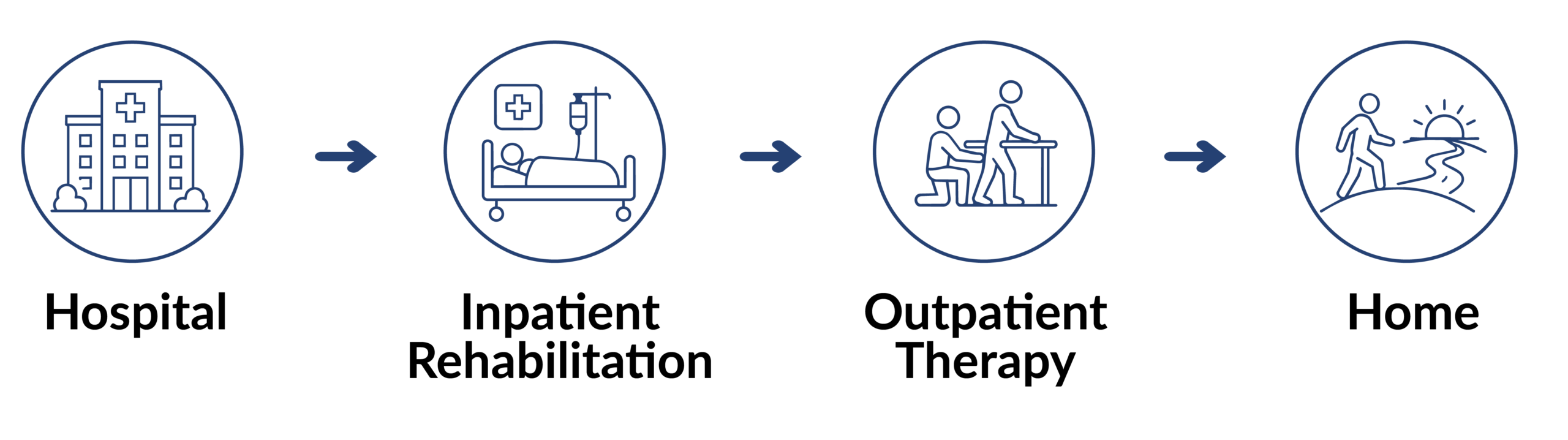
Our teams work closely with hospitals, physicians, and families to ensure a smooth and safe transition.

Who Needs Inpatient Rehabilitation?
Patients admitted to an IRF require intensive therapy and ongoing medical management that cannot be provided in a lower-level care setting.
Common conditions include:
- Stroke and neurological conditions
- Orthopedic injuries or joint replacement
- Spinal cord conditions
- Complex medical or surgical recovery
- Cardiac or pulmonary conditions requiring rehabilitation
- Difficulty performing daily activities
- Amputation/limb loss

What is an Inpatient Rehabilitation Facility?
An inpatient rehabilitation facility provides resource-intensive rehabilitative care to patients in a hospital setting with daily physician oversight and coordinated therapy services.

Medical Oversight
- Care led by a physiatrist (rehabilitation physician)
- Certified rehabilitation nurses and case managers
- Ongoing medical supervision and treatment

24/7 Clinical Support
- Around-the-clock nursing care
- Respiratory therapy services when needed
- Close monitoring of medical conditions during recovery

Intensive Therapy Program
- Physical, occupational, and speech therapy
- Minimum of 15 hours of therapy per week
- Interdisciplinary team approach to recovery

Much More than Physical Therapy
When referred patients come to us, they have various medical conditions. Whittier IRFs offer an expert medical team to tailor patient programs to their specific medical and rehabilitation needs. Patients with acute or chronic illnesses receive additional support concurrent with therapies for functional requirements. For this reason, IRFs in Bradford and Westborough are licensed in the state of Massachusetts the same as the typical community hospital, which renders care for acute conditions.
Our on-staff and consulting physicians come from various specialties: physiatry, neurology, pulmonology, nephrology, infectious disease, and mental health, along with other supporting medical consultants. Hospitalists manage day-to-day medical needs and treatments in collaboration with the physiatrist and the rest of the IRF team.
Recovery Success at Whittier's IRFs
We know the little things matter most during recovery. For the patient re-learning activities of daily living, the small victories lead to larger ones: picking up a spoon to eat independently can lead to higher-level tasks like cutting food or preparing a meal. Therapy that starts with simply raising one’s arms, or sitting on the edge of the bed, can progress to retrieving a can of soup or standing unassisted.
Patients also practice more complex maneuvers, such as walking up and down stairs, preparing a meal, or transferring in and out of a car. Whittier’s therapists are here to celebrate the patient’s progress, motivating them every step of the way.

What To Expect During an IRF Stay
Every rehabilitation journey is unique, but most inpatient rehab stays follow a similar progression.
- Transfer from hospital following illness or injury
- Typical stay of 2 weeks, depending on individual needs
- Participation in intensive therapy programs
- Ongoing medical monitoring and progress evaluations
- Discharge planning begins early
- Return home or transition to outpatient therapy
Focused Therapy Leads to Better Recovery
Patients treated in inpatient rehabilitation settings experience strong outcomes and improved independence.
Key benefits of IRF Care
- Intensive therapy of 15 hours per week
- Daily medical supervision
- Coordinated interdisciplinary care
- Lower hospital readmission rates
- Personalized, goal-driven treatment plans
- Discharge planning begins on day 1
Speak with an Admissions Coordinator
Our admissions team works closely with hospitals, providers, and families to coordinate transfers and guide the referral process.

Central Admissions Office
(800) 442-1717